

Today is the 80th anniversary of the end of World War II in Romania (Western European countries celebrate this – the end of the war in Europe – on May 8).
In the spring of 1945, Politehnica Timișoara continues training matches. In April, the team took part in the Freedom Cup, then, in the very last days of the war, at the beginning of May, in the Easter tournament in Bucharest.
On April 8, 1945 we note the first foreign player in the history of Politehnica, the Soviet Bagdasarov (a lieutenant in the Red Army, an army that was in the country…)! He was introduced at half-time in the friendly at home against Chinese-CAMT (score 6-1 for the students). He played left winger and scored the last goal of the match in the 88th minute. However, he was not also legitimized at the club.
At the initiative of Prof. Gheorghe Cristodorescu, the team was strengthened with players such as A. Boroș, Corbuș, Andreescu, Andrei Rădulescu, Ion Vasile, R. Marcu, thus explaining the clearly superior results. This is the period when the club starts to transfer players in order to increase the team’s sports performance. Even if it was a war period, without official competitions. Most of the team’s players were still students.
Rudolf Bürger, the famous former Rhine international Rudolf Bürger, who had played in the 1930 and 1938 World Cups, was the coach.
The team began to be referred to in the media as “Poli” or… “Poly”.
In the period after the Vienna Dictatorship, the team from Oradea, the CAO (which became NAC under its Hungarian name) managed to win the Hungarian championship in 1944 (the official championship, not the unofficial ‘war’ championship like Romania had during the conflagration)! Among its players were Simatoc, Juhasz, Demetrovics and, above all, Petschowski.
Once the war was over, Poli continued their friendly matches.
On July 3, 1945, they played their second international match, winning 4-1 at home in a friendly against Zugloi MaDISz Budapest (the “progressive youth” team).
Then, on September 25, Crvena zvezda Belgrade (a club just founded on March 4, 1945, and which would become world famous) plays a friendly in Timisoara against the local Politehnica – Victoria team, winning 2-1 (match report, in photo).
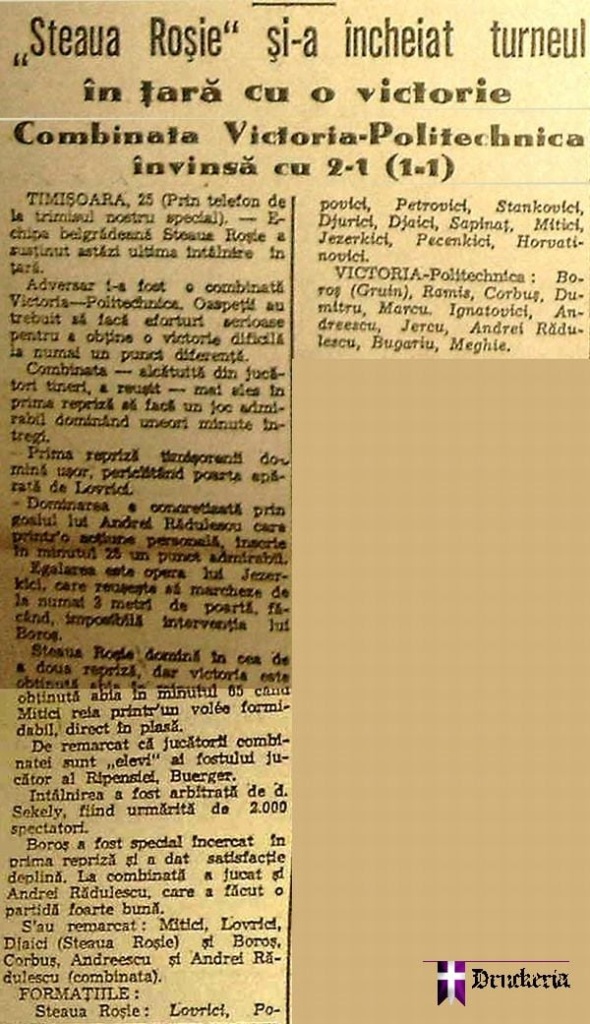
In the space of not even three months, Politehnica played matches against teams from the capitals of the two countries neighboring Timișoara (Hungary and Yugoslavia respectively).
Poli also had an important game (for the future) on July 27, 1945, away, in Arad, against another newly created group (on April 18 of the same year), ITA. The future UTA. It would become Baron Neuman’s legendary team, would categorically dominate the first years of post-war Romanian football and would be Politehnicii’s great rival. Score: 2-2!
That summer, Poli took part in a big friendly competition between teams from Timișoara, the Union Championship.
And in the national team’s first match after the war, on September 30, 1945, in Budapest (a catastrophic 2-7 friendly against Hungary, away from home), two Polists, goalkeeper A. Boroș and stopper Ion Vasile!
The official competitions also resumed (but not, as yet, the national championship; this would happen in the following season). In category I of the Timișoara City Championship (the new name of the District Championship) in 1945/46, with Rudolf Bürger on the bench, Poli finished first, tied on points with second place CFR! They would have had the right to be promoted to the first post-war edition of the Diviziei Naționale A, but the federation decides to have a play-off between the two teams. After a 1-1 draw (with the hosts CFR) and a 3-1 draw (with the hosts Poli), the feroviarii qualified. It was then that the rivalry between Politehnica and CFR was born…
The Second World War ended on September 2, 1945 with the Allied victory.
After the war, Romania fell under the influence of the USSR and gradually became a communist country. On December 30, 1947, the monarchy is overthrown (the last king, Mihai I) and a republic is proclaimed (led by the communist Gheorghe Gheorghiu Gheorghiu-Dej). The country’s name becomes the Romanian People’s Republic (abbreviated RPR) (between 1954-1965, the spelling was Republica Populară Romînă). In practice, the country will be known as the “stateless” RPR, then R.P. Romînă (in short Romînia).
In 1948, professionalism will be banned in Romanian football (it will continue in the form of a disguised professionalism, with the tacit consent of the authorities).
The foreground of post-war football in Timișoara will be held by CFR and, especially, Politehnica. Nothing will ever be the same. In all the years that followed, Timisoara would never win another title. Only two trophies (both in the Romanian Cup), through Poli, in 1958 and 1980…
Still living in the fabulous “production” of the inter-war years, Timișoara would hold the flag high for a while. Ripensia and Chinezul, the most glorious Romanian teams until then (along with Venus and Rapid from Bucharest), will be disbanded by the new communist power. Chinezul-CAMT (as it was then called) disappears in 1946 (when CAMT is re-established, but it will also disappear after 1949), and Ripensia in 1948. The Chinezul – Ripensia relay relay was replaced by CFR – Politehnica. Capitalist-style football is replaced by trade union football, with local management in the hands of party activists.
Photo from introduction: CFR Timisoara – Politehnica Timisoara, 1946 (Source: Facebook Politehnica Timisoara – file de istorie)
Excerpt from the book “Politehnica Timișoara – Football and Handball”, by Octavian Stăncioiu and Viorel Jurcuț, published by Editura Politehnica, on December 4, 2021, on the occasion of the Centenary of the Politehnica Timișoara Sports Society
 English
 Dutch
 French
 German
 Romanian
 Spanish