
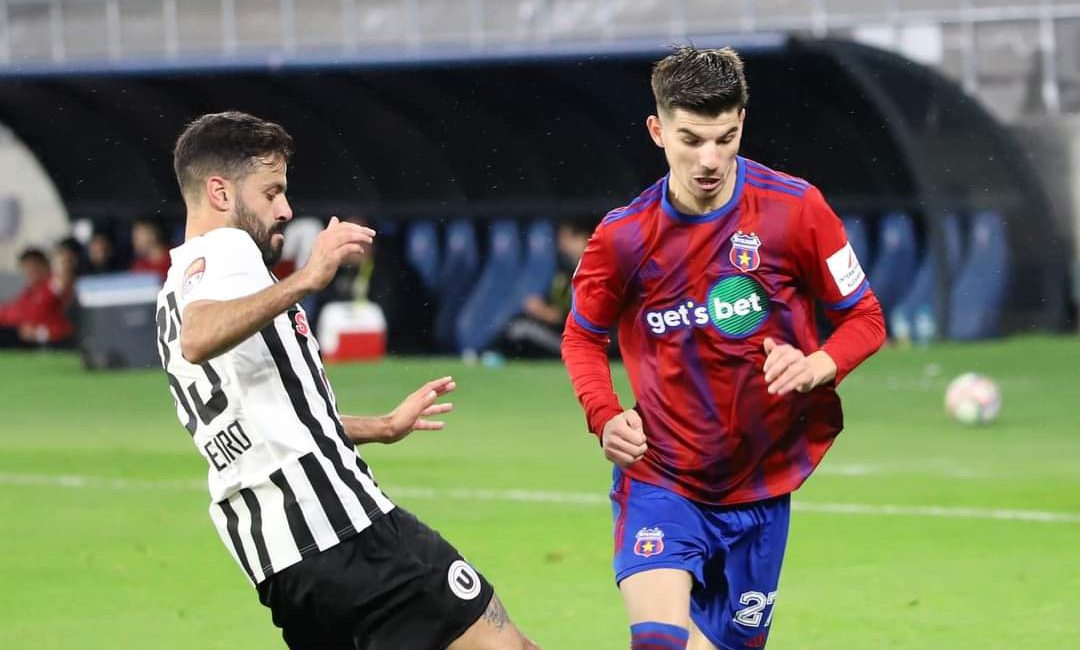
In 1947 the War Ministry team, AS Armata București, was established. The team was entered directly into the first echelon. Later it was called CSCA, CCA and (from 1961) Steaua. The club colours, red and blue.
It would become the club with the most important achievements in the history of Romanian football, holding the record for national titles (26), Romanian Cup trophies (23), Romanian Super Cup (6) and Romanian League Cup (2). In 1998, it also equalled the record for consecutive national titles (six), held by Chinezul Timișoara.
Enjoying the extremely strong involvement of Valentin Ceaușescu, the eldest son of dictator Nicolae Ceaușescu, the group of soldiers from Bucharest would play a major role in European club football for four years, starting in 1985.
On 7 May 1986, Steaua scored the greatest achievement in the history of Romanian football, becoming the first team from Eastern Europe or a communist country to win the European Champions Cup (today’s Champions League). In the final played in Seville, the opponent was FC Barcelona. 0-0 after extra time and 2-0 to Steaua on penalties, with Duckadam defending all four shots that were taken! Steaua’s line-up in that final: Duckadam – Iovan, Bumbescu, Belodedici, I. Bărbulescu – L. Bălan (73, A. Iordănescu), Bölöni, G. Balint, Majearu – Lăcătuș, Pițurcă (112, Radu II). Coach, Emerich Jenei.
A few years later, Steaua shone in the European sky, playing three more finals: winning the 1986 European Super Cup (1-0 against Dinamo Kiev in 1987), losing the Intercontinental Cup (0-1 against River Plate Buenos Aires in 1986) and the ECC (0-4 against AC Milan in 1989). Steaua also reached the semi-finals of the UEFA Cup (1987/88). In the winter of 1987, Gh. Hagi.
After the 1989 Revolution, Steaua would play several times in the Champions League group stage and reach only one European Cup semi-final, in 2006, in the UEFA Cup, after eliminating Rapid București in the quarter-finals, in the only meeting between Romanian teams in the history of the European Cups. Since 2003, Gigi Becali has been the club’s owner.
In 2014, the court annulled the Steaua București trademark registered by the club, in a lawsuit brought against it by the Army Sports Club (CSA Steaua), a club belonging to the Ministry of National Defence. As a result, in 2017, the name of Stele (Gigi Becali’s) became FCSB.
In 2015, CSA Steaua sets up a football section, at first with only children’s and junior teams. In 2017, the senior team is established, registered in D4. It will be promoted to League II in 2021, without the right of promotion to League I, due to the club’s form of organisation.
Stele’s palmares are currently disputed by FCSB and CSA Steaua. In 2019, CSA Steaua won a first court ruling on the matter.
In 2021, the new Steaua stadium in Bucharest (31,254 seats) was inaugurated, built on the site of the old arena of the same name in the Ghencea district.
The latter stadium had been inaugurated in 1974 (demolished in 2018) and it was there that the club’s great European successes were achieved. It was also the venue for most of Romania’s home matches during the “Golden Generation” period.
Photo source: CSA Steaua Bucharest
Article written by Octavian Stăncioiu, Politehnica Timișoara spokesman
 English
 Dutch
 French
 German
 Romanian
 Spanish