
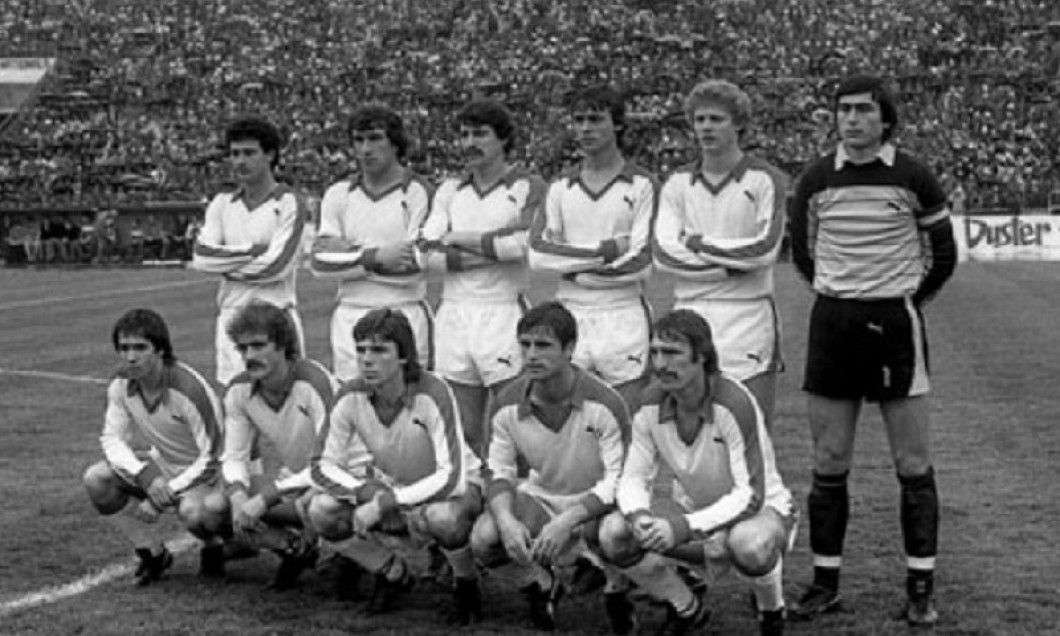
A club of the Ministry of the Interior, founded in 1948 (three years after the Red Army had entered Romania by tank), Dinamo Bucharest was created after the “Dinamo” model, a club model of police forces established by the USSR in the countries it had conquered after the war. Thus was born a team that would become one of the two “greats” of Romanian football. Bearing a name that in Romanian means nothing.
In the return leg of the 1947/48 championship, towards the end of the edition, Unirea Tricolor (called at that time Unirea Tricolor MAI, being already sponsored by the Ministry of Internal Affairs) and Ciocanul were disbanded, they “merged” to create Dinamo. The year before, the future Steaua had appeared.
Dinamo was never loved in Timișoara. During the communist period, Timișoara was the most anti-communist city in Romania, and Dinamo represented the new order in the “Socialist Camp”. The reasons: the way it came into being, what this group represented, the methods it practised until the Revolution (transfers “with a bark”, blackmail and threats against opposing clubs and players, pressure on referees).
Dinamo was, however, an elite Eastern European team. It was the first Romanian team to reach the ECC semi-finals in 1984. But it will never play in the Champions League group stage…
The Cup Winners’ Cup semi-final in 1990 is also worth mentioning, when coach Mircea Lucescu had built a legendary team, which would abruptly stop its rise, that very year, by transferring most of its starters to foreign clubs, a situation made possible by the 1989 Revolution.
Over the years, Dinamo has written history with players such as Suru, Băcuț I, Nunweiller III, Pîrcălab, M. Lucescu, Cornel Dinu, Dudu Georgescu, D. Moraru, Augustin, Rednic, Cămătaru, Mateuț, Răducioiu and Dănciulescu.
Last summer, Dinamo was relegated from the top flight for the first time in its history.
The club is now (for the second time!) insolvent. Since the winter of this year, the club has a new management. The club’s colours are red and white.
Not even the club’s own stadium is what it used to be. Dinamo’s stadium is not even approved for the second division anymore and its reconstruction is awaited.
 English
 Dutch
 French
 German
 Romanian
 Spanish