
In 1953 Dinamo Pitesti was founded as a “satellite” of Dinamo Bucharest. Until then, the supremacy in Pitești football had been held by Sporting Pitești, which had not even made it to the first division!
In 1961, Dinamo Pitesti was promoted for the first time to the A division, and in 1966 it achieved its first performance, reaching the European Cup of Nations (now the European League), eliminating Sevilla, Toulouse (5-1 in the return leg, after 0-3 in the first leg!!) and losing to Dinamo Zagreb.
In 1968, Dinamo Pitesti adopted the name FC Argeș and became the first exclusive football club founded in Romania since the mid-1940s. The club has the white-violet colours.
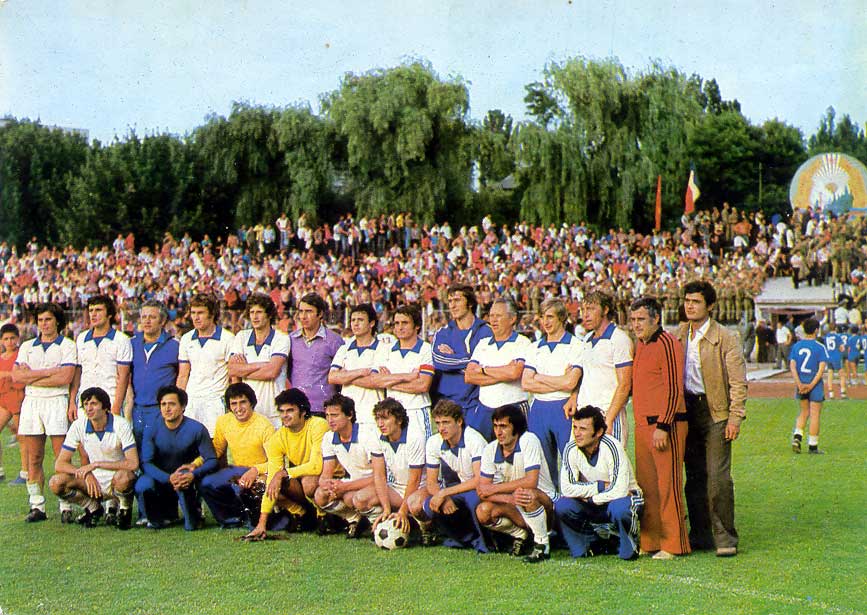
Already in the Dobrin era, the team would win two titles in just seven years: in 1972 and 1979! The last one, after a decisive 4-3 away win over rivals Dinamo (Bucharest) in the last round! In both, the legendary Florin Halagian was coach, and the stars were Olteanu, I. Barbu, Radu I (in ’72), Cristian, Doru Nicolae, Radu II (in ’79), plus, in both cases, Dobrin.
Memorable victories were against Real Madrid (2-1 at Pitesti in 1972 in the UEFA Cup), Valencia (2-1 at Pitesti in 1978 in the UEFA Cup) and the elimination of Panathinaikos (in 1978 in the UEFA Cup) and AEK Athens (in 1979 in the UEFA Cup). But also a 0-7 with Celta Vigo (in 1998, in the UEFA Cup)… He played two finals in the Balkan Cup and one in the Romanian Cup.
Coach Leonte Ianovschi set up an extraordinary football school at the club decades ago. Almost year after year, since the seventh decade, this school has produced quality players. Let’s just mention Dobrin and those of recent years, Neaga, D. Coman, N. Dică, Cr. Tănase, plus the best Romanian player after the “Golden Generation” (next to Chivu), Mutu.
After the boom of the 70s, Argeș entered a shadowy period. For a while, the name Dacia appeared in the name, the famous local car factory being the club’s patron.
FC Argeș disbanded, going bankrupt, in 2013, when it was in League II. “Clones” were created, SCM Argeșul, Academica Argeș, but also FC Argeș 1953, supported by supporters.
However, in the summer of 2017, FC Argeș was re-established, with Pitesti City Hall acquiring the brand and “applying” it over SCM Pitesti (formerly SCM Argeșul). The latter had just been promoted, for the first time, to the Second League, with Nicolae Dică as coach (then moved to FCSB). Basically, FC Argeș absorbed SCM Pitesti.
In 2020, it was promoted to League I.
***
Until the 1990s, i.e. until Gh. Hagi, Dobrin was considered the greatest player in the history of Romanian football. Nicolae Dobrin was born on August 26, 1947, in Pitesti, and is a product of the current club FC Argeș. He was the youngest player ever to play in Division A, making his debut for Dinamo Pitesti on 1 July 1962, when he was only 14 years and 10 months old!!! His entire high-level career was spent at FC Argeș, which he led to the conquest of two national titles.
He was part of the Romanian national team (for which he made his debut at 19 years old) at the 1970 World Cup finals in Mexico, but was not used at all by the rigid coach Angelo Niculescu!
In 1972 he had an offer from… Real Madrid, but could not honour it, the country’s management blocking his departure. That same year, on 14 December, he was invited to the retirement match of the great Gento, playing alongside him and Eusebio in a Real shirt!
He was named Romanian player of the year three times (1966, at the first edition, 1967, 1971). Nicknamed the “Prince of Trivale”, he was a fabulous footballer, midfielder or striker, scintillating in technique and vision of the game.
After retiring from playing (towards the end of his career he played for CS Târgoviște) he was a coach, managing FC Argeș several times.
He died ill on 26 October 2007 in Pitesti. He was only 60 years old. The stadium in Pitesti bears his name. He was posthumously decorated with the National Order “Serviciul Credincios” in the rank of Knight.
Photo: FC Argeș, national champions in 1979; Dobrin is third from the right, top.
Article written by Octavian Stăncioiu, Politehnica Timișoara spokesman
 English
 Dutch
 French
 German
 Romanian
 Spanish